
Lewis County Projected Release Dates
Idaho’s public records use several precise labels instead of one universal projected date. The IDOC detail page can show a Sentence Satisfaction Date for an active sentence. It may also show Released to Supervision, a Next Parole Hearing Date, or a Retained Jurisdiction End Date. These are different events. Sentence satisfaction concerns the maintained sentence endpoint. Release to supervision records a community placement. A hearing date marks consideration, not release.
A pretrial detainee often has no sentence-based release date. Bond, a court order, dismissal, time served, transfer, or another case may control the next event. For a Lewis County booking, first ask the Sheriff which jail actually holds the person because the local jail is reported closed. The holding jail can explain its maintained custody calculation, while the Lewis County case shows the legal authority.
| Public label | What it means |
|---|---|
| Sentence Satisfaction Date | IDOC’s published endpoint for an active sentence |
| Released to Supervision | Most recent placement on parole or probation |
| Next Parole Hearing Date | Commission consideration date, not a promised exit |
| Tentative parole date | Conditional Commission date subject to remaining steps |
| Discharged | Stronger evidence that the listed IDOC jurisdiction ended |
Find Lewis County Release Dates
The reliable sequence starts with the court judgment. It states the sentence and identifies whether terms run at the same time or one after another. Then open the IDOC Resident/Client Search for a state commitment. Match the IDOC number, sentencing county, case, and offense before reading any date. A name alone can select the wrong person.
- Identify whether the person is pretrial, serving county jail time, committed to IDOC, or in federal custody.
- Read the current judgment and amendments in the correct court case.
- Confirm jail credit and whether sentences are concurrent or consecutive.
- For IDOC, open each active sentence row and copy its exact labels.
- Review the Commission decision if parole affects the expected path.
- Request the official sentence calculation when a public field is unclear or disputed.
- After the date, verify the actual event with the custodian rather than assuming release.
The IDOC search warns that public data may not be current. Save the check date and IDOC number. For county jail time, obtain the jail’s own calculation. No Lewis County written weekend-release or local good-time policy was found, so do not import a rule from another Idaho jail.
Lewis County Sentence Satisfaction Date
The IDOC detail interface is central to Lewis County state-prison research. Its Sentence Satisfaction Date is the published endpoint on an active sentence, but it should not be called the date the person left prison. A person can be “In community” on parole or probation before that endpoint. Conversely, a person can remain “In custody” even after a parole grant while release steps remain unfinished.
The official active-sentence example shows the labels used by IDOC. It documents the interface, not a Lewis County individual.
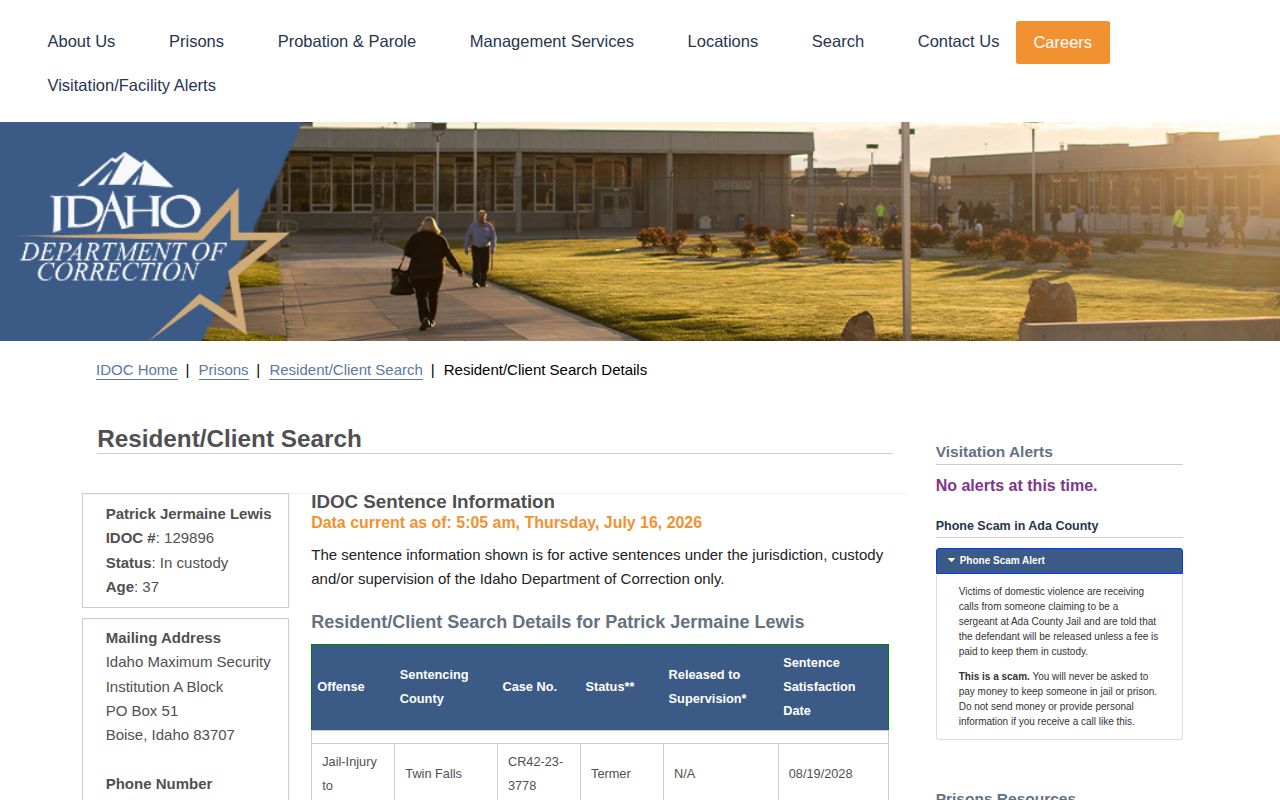
The screenshot demonstrates why a sentence endpoint and parole-hearing field must remain separate when reporting a projected release date.
IDOC Sentencing Records reviews judgments, calculates sentences, applies jail and retained-jurisdiction credit, and processes parole forfeiture. Request its calculation when the legal structure cannot be reconstructed safely from the public view. Do not publish a personal calculator based on a news report or a sentence headline.
Lewis County Unified Sentences
Idaho Code § 19-2513 uses a unified sentence with a fixed term followed by an indeterminate term. The fixed portion is the minimum period of confinement. The indeterminate portion sets the remaining maximum exposure. Parole consideration after the fixed term is discretionary, so the minimum does not become a guaranteed gate date.
There is no verified blanket rule that every Idaho prisoner serves 85 percent. Idaho’s structure should be described from the judgment and the official maintained record, not reduced to that slogan. Offense date, enhancements, consecutive terms, retained jurisdiction, and later court orders can all change the analysis.
A Lewis County case may begin in a county holding facility and later move to IDOC. The county departure is then a transfer, not a prison release. Use the court case and movement record to connect those systems without treating the first roster disappearance as freedom.
Lewis County Good-Time Rules
Idaho does not use a generic day-for-day rule that a reader can apply to a modern prison sentence. Idaho Code § 20-101A’s ordinary good-conduct deduction applies to offenses committed before July 1, 1986. For later offenses, § 20-101D authorizes a narrow, discretionary meritorious reduction for extraordinary heroism or outstanding service of the statutory kind. It is not routine earned time.
County jail statutes and practices may address labor or good-conduct credit, but eligibility depends on the sentence and custodian. Ask the actual holding jail for its maintained calculation. This is especially important in Lewis County because another facility may house the person. No research supports assigning Nez Perce County’s practices to every Lewis County booking.
Jail credit, a corrected judgment, consecutive or concurrent structure, retained-jurisdiction credit, parole forfeiture, absconding time, and other events can alter the official endpoint. Under § 20-1007, absconding days may affect the full-term date, and parole street time may be forfeited. The responsible agency must apply those events.
What Changes Lewis County Dates
A date may move for legal, custodial, or administrative reasons. The correct response is to identify which agency owns the changed field and obtain its current record. Never change the number independently because one event may affect several consecutive sentences in ways that are not visible from a summary.
| Event | Source to check |
|---|---|
| Judgment or amendment | Lewis County iCourt case and clerk |
| Jail or retained-jurisdiction credit | IDOC Sentencing Records or county custodian |
| Parole grant, denial, or rescission | Commission Notice of Action Taken |
| Absconding or parole forfeiture | IDOC calculation and official action |
| Detainer or transfer | Holding agency and receiving custodian |
| Database timing | Live IDOC detail and records request |
A detainer is another agency’s request or legal basis to hold or receive the person. It can block community release even when the first sentence date arrives. Ask for the destination. A move to another county, IDOC, ICE, or federal custody is not the same event as walking free.
Lewis County Parole Date Checks
The Idaho Commission of Pardons and Parole publishes hearing schedules and decisions. A scheduled hearing shows only that consideration is planned. A grant shows Commission authorization subject to stated terms, not actual release. A tentative parole date may still depend on an approved plan, programs, transport, paperwork, and the absence of holds.
Use a three-source check: read the Commission calendar, obtain the later decision, then return to IDOC. The strongest public evidence of actual community placement is a status transition from “In custody” to “In community” with Released to Supervision. If IDOC still shows custody after a tentative date, ask the Commission or IDOC about the gap.
Post-release supervision and the displayed District 2 assignment are explained on the Lewis County Parole / Probation page. Sentence completion is still separate. Look for a discharged status or formal discharge evidence when the question is whether all IDOC authority ended.
Lewis County Jail Release Timing
For a county sentence, use the judgment, jail-credit entry, and the actual jail’s calculation. The Lewis County Sheriff should identify the physical custodian. Ask whether the stated date is based on a court order, served sentence, bond event, or another authority, and whether any other agency has a hold.
Weekend and holiday processing should be confirmed with that facility. No verified Lewis County policy promises early release when a date falls on a closed office day. Jail operations and public-record office hours are also different. A court can order immediate release, but the custodian must process the order and resolve other valid holds.
- Ask for the booking and case numbers.
- Confirm the exact judgment and jail-credit amount used.
- Request the maintained release calculation.
- Ask about detainers and the destination of any transfer.
- Afterward, obtain the release timestamp, type, and authority.
Cross-check the case in Idaho iCourt. The court record can explain why custody changed, while the jail record establishes what the custodian processed. Both are needed when a live roster no longer shows the name.
Verify Lewis County Actual Release
A projected date remains provisional until the event occurs. For IDOC, recheck status and Released to Supervision. For a jail, obtain the release entry. For BOP, use the federal locator’s release language. For ICE, use the official detainee locator and ERO contact, keeping its limited post-release coverage in mind.
VINE can add a fast notice, but it may not state the reason or destination. Register through the matching agency record and then call that agency if an alert says “released.” The Lewis County VINELink Release Check covers registration, identifiers, PIN use, and transfer limits.
Record each claim narrowly: “Sentence Satisfaction Date displayed,” “parole granted,” “Released to Supervision displayed,” or “holding jail recorded community release.” Those phrases preserve the difference between a calculation, authorization, community placement, and final discharge.
Public Record Search
Sponsored Results