
Lewis County Parole and Probation
Parole and probation both allow a person to live in the community under rules, but they begin in different ways. Parole follows a prison commitment and is authorized by the Idaho Commission of Pardons and Parole. Probation comes from the sentencing court. Idaho Department of Correction Probation and Parole officers conduct field supervision for both groups. A person may therefore appear as “In community” in the IDOC Resident/Client Search while still serving an active sentence.
Release from a building is not the same as discharge from the sentence. An IDOC detail may show “Released to Supervision,” an active probation or parole status, a supervising district, and a Sentence Satisfaction Date. These fields answer different questions. The first marks the most recent placement on community supervision. The satisfaction date is the maintained endpoint for an active sentence. Final discharge is better shown by a discharged status or an official discharge record.
| Feature | Parole | Probation |
|---|---|---|
| Starting point | Release from an Idaho prison term | Sentence ordered by the court |
| Authority | Commission parole action and IDOC records | Court judgment and IDOC records |
| Public verification | IDOC detail, Commission decision, court case | IDOC detail and court case |
| End point | Discharge or sentence completion | Discharge, completion, or later court action |
Check Lewis County Supervision Records
The IDOC Resident/Client Search is the best public starting point for a named person with an Idaho state sentence. Search by name, then use the IDOC number, birth year, sentencing county, case number, and offense to avoid a same-name mismatch. Open every active sentence row. A summary result is not enough because the detail page can identify the supervising office and distinguish custody from community placement.
- Search the full legal name and test known spelling variants.
- Match the IDOC number and case details before relying on the record.
- Read whether the result says “In custody,” “In community,” or “Discharged.”
- Record the supervision type, supervising district, Released to Supervision date, and Sentence Satisfaction Date.
- Open the Lewis County case in iCourt to compare the judgment and later court entries.
- If parole is involved, review the Commission decision and then confirm that IDOC recorded the status change.
A negative name search does not prove that supervision never existed. A record may be historical, entered under another name, or unavailable through the active public view. For a formal answer, use the IDOC public-records channel and provide the identifiers already gathered. The Lewis County release search path on the home page explains how to connect a county booking, holding jail record, and court case.
Lewis County District 2 Supervision
Lewis County is assigned to IDOC Probation and Parole District 2. The main district office is at 908 Idaho Street, Lewiston, ID 83501, and its published phone is 208-799-5030. IDOC also lists an Orofino satellite at 155 Main Street, Suite 2, Orofino, ID 83544, with phone 208-476-4357. These are useful routing contacts for Lewis County supervision questions.
The office shown on the person’s current IDOC detail controls when it differs from the general county assignment. People can move, have cases in more than one county, or receive supervision through a specialized unit. Call the displayed office with an IDOC number and a focused question. Staff may limit personal details, but the official record remains more reliable than assuming the closest office owns the case.
IDOC District 2
Main office: 908 Idaho Street, Lewiston, ID
83501
Phone: 208-799-5030
Orofino satellite:
155 Main Street, Suite 2, Orofino, ID 83544
Phone:
208-476-4357
The published office page below shows the Lewis County district assignment. It should be checked again before an in-person visit because office routing can change.
View the official IDOC District 2 office listing.
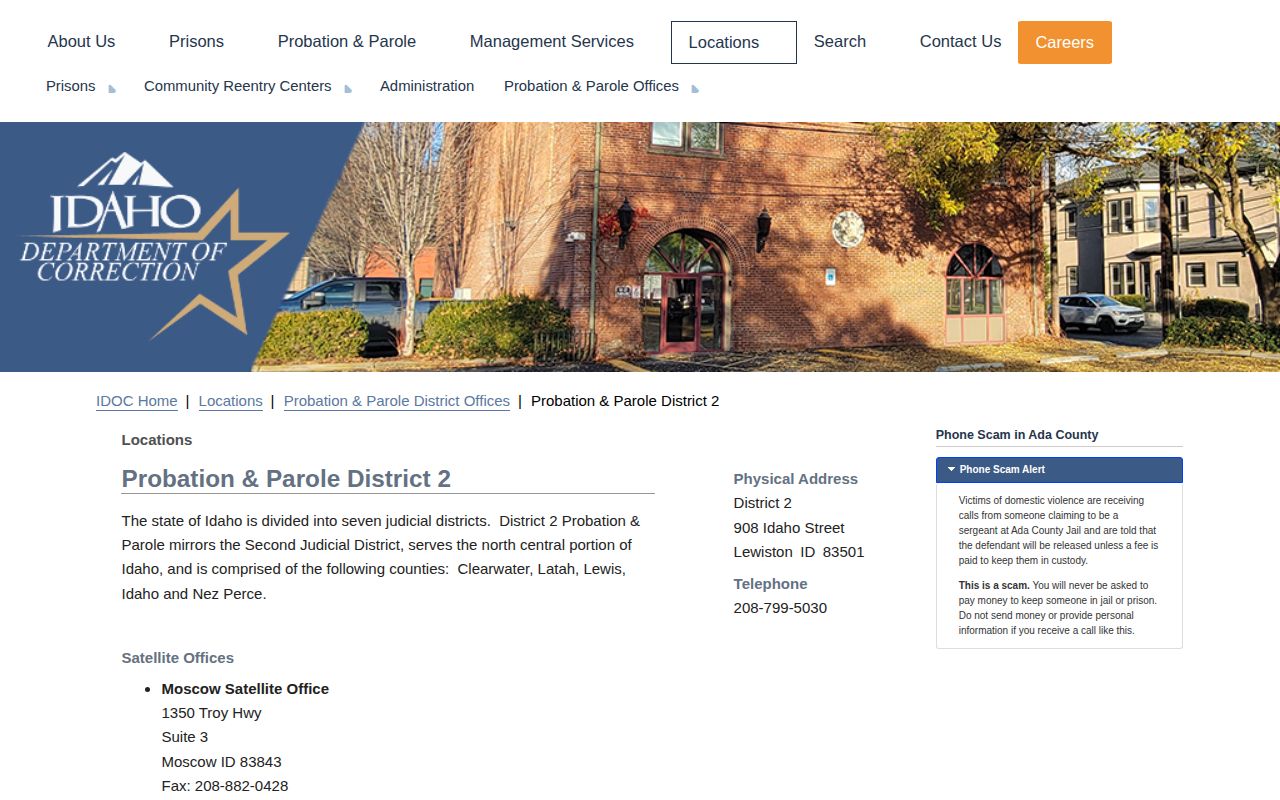
The screenshot anchors the county assignment to an official IDOC source, while a person-specific detail remains the final routing authority.
Read Lewis County Supervision Fields
An IDOC detail record combines status, sentence, and contact fields that should not be collapsed into one claim. “In community” supports physical placement outside an IDOC prison as of the database entry. It does not mean the sentence has ended. “Released to Supervision” is a historical placement date. The displayed parole or probation status describes the type of control, while the supervising district and officer fields route current questions.
The official IDOC example detail demonstrates these field labels. It is an interface example, not evidence about a Lewis County person.
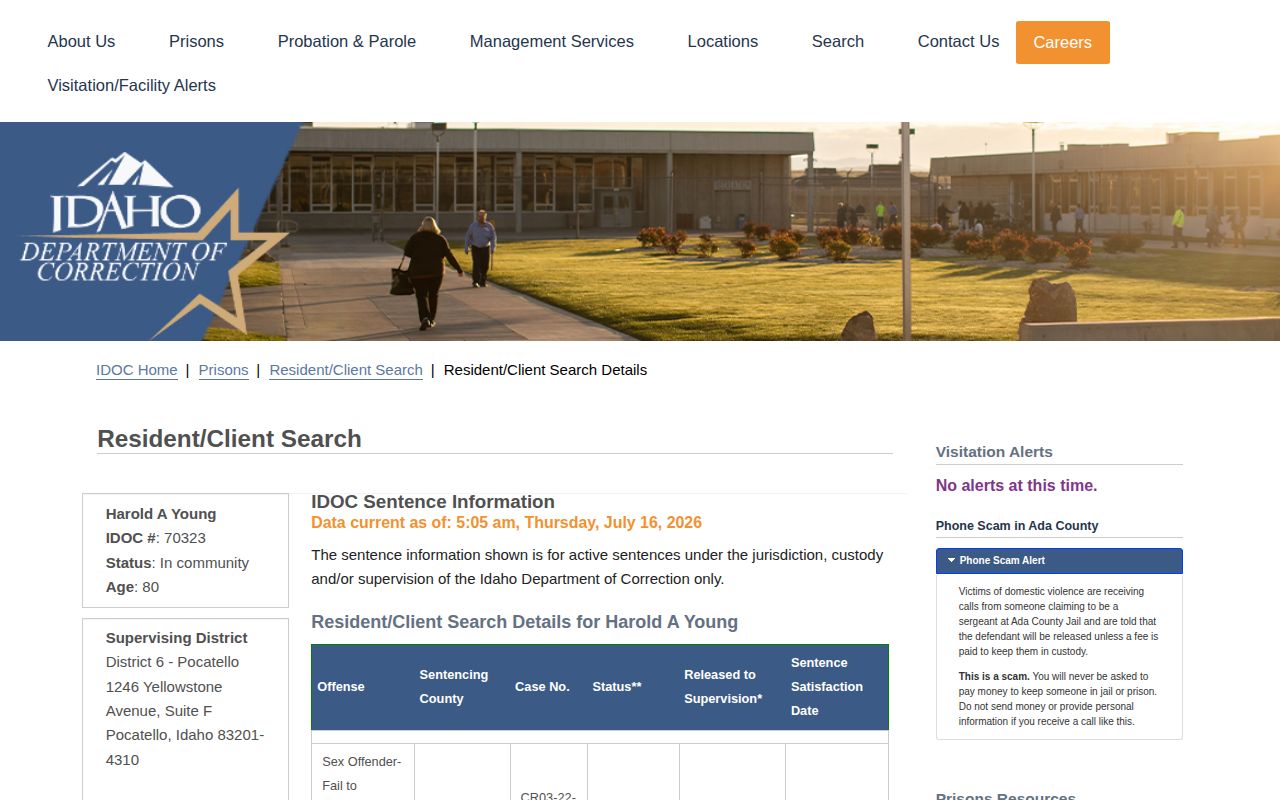
The example shows why the status, supervising office, sentence row, and dates must be read together before describing someone’s release or discharge.
| Field | Careful reading |
|---|---|
| In community | Outside an IDOC prison under a community status |
| Released to Supervision | Most recent placement on supervision, not final discharge |
| Supervising office | Current routing source for appropriate verification |
| Sentence Satisfaction Date | Maintained active-sentence endpoint, subject to change |
| Discharged | Stronger evidence that the listed jurisdiction ended |
Lewis County Parole Decisions
The Commission decides parole matters, while IDOC carries out custody and field supervision. Its hearing schedule can show that a matter is set for consideration. A scheduled hearing does not prove release. Dates and times may change, and the Commission publishes hearing order information through its live page.
After the hearing, consult the Commission decision page. A grant authorizes parole subject to its terms. It is not proof that the person left the institution that day. A tentative parole date may depend on an approved plan, remaining programming, transport, paperwork, and the absence of a hold. Denial, continuation, deferment, rescission, and other labels should be copied exactly from the official notice rather than rephrased.
The verification loop is calendar, decision, then IDOC status. Actual community placement is better supported when IDOC changes from “In custody” to “In community” and publishes Released to Supervision. If those sources conflict, contact IDOC or the Commission instead of guessing which page updated first.
Lewis County Violations and Absconders
Supervision conditions are person-specific. They may address reporting, travel, treatment, contact, restitution, or other duties stated in the court judgment, parole contract, and officer instructions. A violation allegation is not the same as a final finding. The supervising agency and court or Commission record show what action was actually taken.
An absconder is generally a supervised person alleged to have stopped reporting or left approved supervision. That status can lead to a warrant, arrest, or revocation process, but a searcher should not infer the outcome from an old label. Verify the current IDOC detail, the relevant court docket, and any Commission action. Do not approach a person based on a public result. For an urgent safety concern, use the proper law-enforcement channel.
VINE may send custody or supervision-related notices when an agency supplies the event, but it is not a full probation case file. Registration should follow the matching agency record. A transfer, arrest on a violation, or return to custody may create several events, each with a narrower meaning than “supervision ended.”
Lewis County Supervision Discharge
Supervision ends through the authority that controls the case. That may be sentence completion, an IDOC discharge entry, a court order, or Commission action. Idaho Code § 19-2604 offers discretionary relief in qualifying cases, but it does not promise that every booking, court, IDOC, registry, or news record disappears. Each record custodian controls its own system.
For parole, the last supervising district may be able to explain the official discharge documentation available to the person, including a Gold Seal notification where applicable. For probation, compare the IDOC status with the sentencing court docket. If the public IDOC detail no longer carries an active row, request the historical or certified record rather than assigning a date from memory.
A complete proof packet uses the IDOC number, the relevant sentence row, Released to Supervision, current status, the court case, and the final discharge source. Keep dated copies because live records can change. Corrections should be sent to the agency that owns the disputed field, with sensitive identifiers redacted unless the official channel requires them.
Public Record Search
Sponsored Results